CONACYT is the Mexican National Council of Science and Technology. Cimav is a CONACYT research center in advanced materials. iDEA is a company of engineering, electronic development and automation.
Cimav and iDEA developed the Experimental Magnetic Refrigerator CoolMag.
Magnetic refrigeration is an emergent technology, and to produce cooling you need a magnetocaloric material, a magnet and a heat transfer fluid working in a Brayton thermodynamic cycle.
Magnetic refrigeration has the potential to consume less energy than conventional vapor compression refrigeration.
Magnetic refrigeration use an environmental friendly magnetocaloric solid as the working material, while conventional refrigeration uses clorofluorocarbons which damage the ozone layer and produce greenhouse effect.
Magnetic refrigeration does not use a compressor and therefore is silent.
In CoolMag lanthanum-calcium-strontium manganites are used as magnetocaloric materials inside a multilayer regenerator through which a mixture of water with ethylene glycol flows to exchange heat.
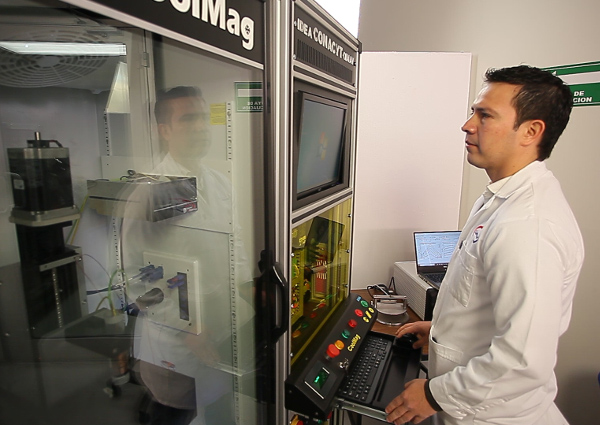
- Magnetic Refrigerator Prototype
Designed and constructed by iDEA (Ingeniería en Diseño Eléctrico y Automatización S.A. de C.V.) and CIMAV (Centro de Investigación en Materiales Avanzados, S.C.).
With lanthanum-calcium-strontium manganite as magnetocaloric material and with a multilayered
regenerator to enhance the cooling power.Thermal diodes of metamaterials are been developed to improve heat exchange and increase the operation frequency of the refrigeration cycle.
- Materials Preparation
Magnetocaloric manganite was prepared by 4 routes.
The magnetocaloric effect varies with the preparation method:
- Solid state synthesis (ceramic method using planetary mill)
- Solid state synthesis (ceramic method using attritor mill)
- Microwave assisted sol-gel synthesis
- Conventional sol-gel synthesis
- Magnetic Refrigerator Regenerator
Magnetocaloric plates that feed the multilayered regenerator were consolidated by spark plasma sintering.
- PPMS Measurements
The magnetocaloric effect was measured with a Quantum Design PPMS VSM probe.